Watchly Safety Review

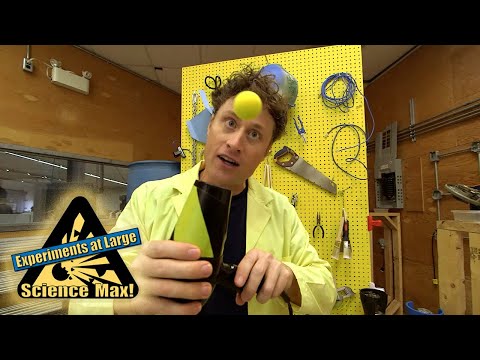
What Is Bernoulli's Theorem? | Giving Objects Lift | Mini Max | Science Max

Science Max - 9 Story
1:31 · 19K views · June 1, 2023
All reviews →
Safe for Most KidsReviewed June 2026

This episode is safe for most kids and offers a fun, hands-on demonstration of Bernoulli's theorem using a hair dryer and ping-pong ball, though the 'max it out' segment with a giant hair dryer and ball may be more about spectacle than deep science. The video excels at making a physics concept tangible and memorable, but parents should note the presenter's playful, fast-paced style and lack of detailed explanation beyond the core principle.

What Parents Need to Know

This video is a short, engaging demonstration of Bernoulli's theorem, showing how fast-moving air creates low pressure that can lift a ping-pong ball. It does a great job of making a complex physics idea accessible and fun, with a clear 'science is awesome' message. However, the 'max it out' segment is more about visual spectacle than educational depth, and the video moves quickly without explaining the underlying math or real-world applications. There are no safety concerns, but the presenter's energetic style and loud sound effects might be overstimulating for very young children.
Talk to Your Kids About

  1. 1Why does the ping-pong ball float in the air stream instead of falling?
  2. 2Can you think of other examples where fast-moving air or water creates low pressure?
  3. 3What would happen if you tried this experiment with a heavier object, like a tennis ball?
  4. 4How does Bernoulli's theorem help explain how airplanes fly?
What Is Bernoulli's Theorem? | Giving Objects Lift | Mini Max | Science Max
Protected Viewing

What's This Video About?

Here's a cool experiment that demonstrats Bernoulli's Theorem! #ScienceMax #Science #ScienceExperiments (🔔) Subscribe to Science Max for New Videos ▶▶ https://www.youtube.com/@ScienceMax?sub_confirmation=1 Watch MORE Science Max videos: Science Max | FULL EPISODE | Paper Airplane | Season 1 ▶▶ https://youtu.be/Te7ts3909io Science Max | BUILD IT YOURSELF | Paper Airplanes | EXPERIMENT ▶▶ https://youtu.be/NFNsxJt0-HE Science Max | AIRPLANES | Science Experiments ▶▶ https://youtu.be/Ywq3Kh66vGE How to Make and Air Powered Rocket | Science Max ▶▶ https://youtu.be/wWh6pnmhSYA 💡Mini Max - AWESOME Experiments💡 ▶▶ https://www.youtube.com/playlist?list=PLY2vSQEVraKBlc8fX1L1ewBdJO6lEtfSH Have you ever done a science experiment and wondered “What would this be like if it were HUGE?” Welcome to Science Max, the exciting new series that turbocharges all the science experiments you’ve done at home.

Frequently Asked Questions

What age is this video appropriate for?

This video is recommended for ages 5 and up. The simple, visual demonstration of Bernoulli's theorem is easy for young children to grasp, but the fast pace and loud sound effects may be too stimulating for kids under 5.

Is this video safe for my child to watch?

Yes, it is completely safe. There is no strong language, violence, or inappropriate content. The only potential concern is the loud sound effects and energetic presentation, which might startle very sensitive children.

Does the video teach real science?

Yes, it demonstrates Bernoulli's theorem, a real physics principle about air pressure and speed. The demonstration with a hair dryer and ping-pong ball is accurate, though the 'max it out' segment is more for entertainment than deep learning.

Will my child need to understand complex concepts to enjoy this?

No, the video presents the idea in a very simple, visual way. Kids just need to see that fast-moving air can make things float. The explanation is kept basic, so even preschoolers can enjoy the 'wow' factor.

Is there any risk of my child trying this experiment at home?

The experiment shown uses a hair dryer and a ping-pong ball, which is generally safe if supervised. However, the video does not provide safety warnings, so parents should ensure children do not try it with a real hair dryer without adult help, as it involves hot air and electricity.

What does my child learn from this video?

They learn that fast-moving air has lower pressure than still air, and that this pressure difference can create a 'force field' that holds objects up. It's a great introduction to physics and encourages curiosity about how things work.

More from Science Max - 9 Story

See all →
Wild Machines! | Full Episodes | Science Max | NEW COMPILATION1:02:21
Wild Machines! | Full Episodes | Science Max | NEW COMPILATION
882 views·Jun 19, 2026
Safe
Egg Drop Strategy | Science Max #shorts0:55
Egg Drop Strategy | Science Max #shorts
3K views·Jun 15, 2026
Safe
Experiments with FOOD! | Science Max22:26
Experiments with FOOD! | Science Max
4K views·Jun 12, 2026
Safe
Amazing inventions you should see! | Advanced Materials | Science Max #shorts1:01
Amazing inventions you should see! | Advanced Materials | Science Max #shorts
5K views·Jun 8, 2026
Safe

What Watchly checks every video for

Every video is checked against Watchly's 21 content patterns. Here are a few of them.

© 2026 Watchly. All rights reserved.
Not affiliated with YouTube or Google. All creator content remains property of original creators.