Last Updated: November 2, 2026
Quick Summary
Yes, for many children blue light can disrupt sleep by signaling the brain that it is still daytime, which can delay sleepiness. Evening screen light can slow melatonin release, so it often takes longer to fall asleep. Screens should be turned off about an hour before bed, though the right cutoff depends on age.
- Light from phones, tablets, and TVs can make the brain think it is still daytime.
- Evening light can slow melatonin release, so children may take longer to fall asleep.
- Toddlers should have screens off at least 60 minutes before bed.
- School-age children should have screens off 60 to 90 minutes before bed.
- Blue light filters help only partly; brightness, distance, duration, and content still matter.
Table of Contents
- How Blue Light Affects Your Child's Sleep Clock
- Why Children Are More Sensitive to Evening Screens Than Adults
- How Long Before Bed Should Kids Stop Using Screens?
- Do Blue Light Filters for Kids Actually Help Sleep?
- Building a Bedtime Routine Without Screens
- Managing Child Screen Time at Bedtime Day to Day
- Your Next Step: Setting a Bedtime Screen Cutoff Tonight
- Frequently Asked Questions
How Blue Light Affects Your Child's Sleep Clock
Does blue light really disrupt your child's sleep? For many families, the honest answer is yes, at least in part. Our guide on whether YouTube is affecting your child's sleep and what helps covers the warning signs. Light from phones, tablets, and televisions can send a signal to the brain that it is still daytime, which can push back the time a child feels sleepy.
At Watchly Player, we look at this problem from the parent's side. The science matters, but so does the daily reality of getting a child to bed on time.
Why the body's internal clock is sensitive to evening light
Your child's body runs on an internal clock, called the circadian rhythm. This clock uses light to decide when to be awake and when to wind down. Light enters the eye, reaches special cells in the retina, and tells the brain what time it is.
Blue-rich light is especially strong at this signaling. When it arrives in the evening, the clock can shift later. The result is a child who is wide awake at a time when they should be getting sleepy.
How melatonin production and sleep onset are affected
Melatonin is the hormone that helps the body prepare for sleep. Evening light can slow its release. Less melatonin often means it takes longer to drift off.
Researchers have studied this link, and the size of the effect is generally understood to depend on how bright the screen is, how close it sits to the face, and how long the child watches.
Why Children Are More Sensitive to Evening Screens Than Adults
Children are not just small adults. Their eyes let in more light, and their sleep rhythms can be more easily shifted. Many parents find that children settle less easily after screen time than adults do.
A few things make children more sensitive:
- Their lenses are clearer, so more light reaches the retina
- Their natural sleep timing is still developing
- They have a harder time stopping an activity once it has started
How Long Before Bed Should Kids Stop Using Screens?
Many sleep guidelines suggest stopping screens about one hour before bed, which gives the child time to slow down.
That said, the right cutoff depends on your child's age and routine. A practical starting point:
- Toddlers: Screens off at least 60 minutes before bed
- School-age children: Screens off 60 to 90 minutes before bed
- Teens: Set a firm device cutoff and keep phones out of the bedroom
Start with a cutoff you can actually keep. A rule that works on most nights beats a perfect rule that breaks every other night.
Do Blue Light Filters for Kids Actually Help Sleep?
Blue light filters and "night mode" settings shift the color of a screen toward warmer tones, reducing the blue-rich portion of the light it emits. That is a real change, and it can reduce the light signal reaching the retina. But it is a partial fix, and it is worth being clear about what it does and does not do.
What filters can help with:
- Reducing the overall blue-rich light hitting the eyes in the evening
- Making a screen feel less harsh in a dark room
- Pairing well with dimming the screen and increasing distance from the face
What filters do not fix:
- Brightness. A warm-toned screen at full brightness still delivers a strong light signal. Dimming matters as much as color.
- Distance. A tablet close to the face delivers more light than a TV across the room, filter or no filter.
- Duration. A long session still adds up, even at warmer settings.
- Content. Fast cuts, bright colors, and autoplay keep the brain alert regardless of screen temperature.
- Timing. A filtered screen at 9:45 p.m. is still a screen at 9:45 p.m.
A useful way to think about it: a filter turns down one dial. It does not turn off the other four. Families who get the best results tend to combine a filter with dimming, a firm cutoff time, and content they have chosen deliberately rather than whatever autoplay serves up next.
If your child uses a device for homework or accessibility needs in the evening, filters are a reasonable part of the plan. Schedule the screen work as early as possible, dim the screen, keep it at arm's length rather than close to the face, and switch to audio or a physical book once the work is done. That combination respects the real constraints of family life while still protecting the wind-down window.
Uncontrolled YouTube is a real threat to children's sleep and wellbeing. Hundreds of research papers have examined how autoplay, recommended videos, and unpredictable content affect young viewers, and many of them point to the same concern: the platform is designed to keep children watching. Watchly Player allows you to expose the best of YouTube to your kids, with the rest filtered out and bedtime enforced automatically, so a filter is not the only line of defense in your evening routine.
Building a Bedtime Routine Without Screens
A screen-free routine gives your child something predictable to replace the video. The goal is to make the wind-down feel like a normal part of the evening, not a punishment.
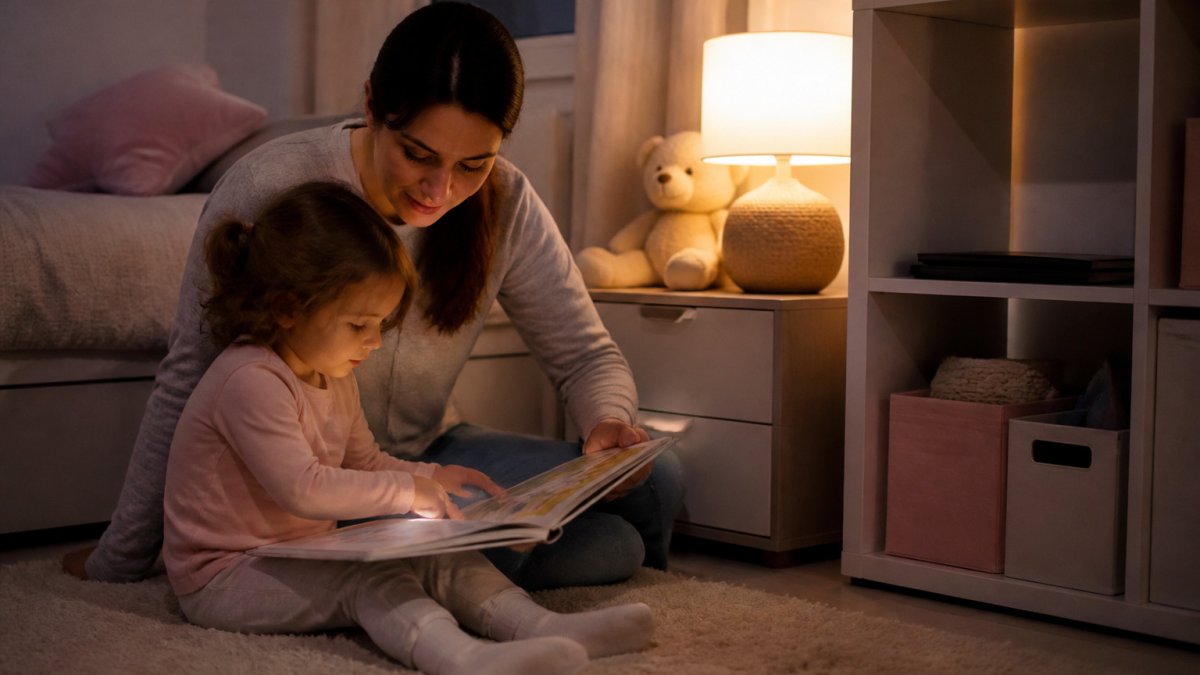
A simple sequence many families use:
- Dinner and a short tidy-up
- Bath or wash-up
- Pajamas and teeth brushing
- One or two picture books
- Lights out at the same time each night
Keep the same order every night. Children settle faster when they know what comes next. For a closer look at how YouTube affects bedtime, read our guide on signs that YouTube is affecting your child's sleep.
!A parent and young child sitting together on a bedroom floor reading a physical picture book by warm lamplight, with a tablet resting closed on a shelf out of reach
Managing Child Screen Time at Bedtime Day to Day
Daily management is where most plans succeed or fail. A rule set once and forgotten rarely holds. Check in each week and adjust.
Practical steps that help:
- Set one device-free time window each evening
- Use a timer so the end of screen time is clear
- Give a short warning before the screen goes off
- Keep devices charging outside the bedroom overnight
The hardest moment is usually the end of a session, when a child is absorbed and does not want to stop. Our guide on why stopping is so hard explains how to ease that transition.
Uncontrolled YouTube is a real threat to children's sleep and wellbeing. Hundreds of research papers have examined how autoplay, recommended videos, and unpredictable content affect young viewers, and many of them point to the same concern: the platform is designed to keep children watching. Watchly Player allows you to expose the best of YouTube to your kids, with the rest filtered out and bedtime enforced automatically.
Your Next Step: Setting a Bedtime Screen Cutoff Tonight
Pick one cutoff time for tonight and stick to it. Write it on the fridge so everyone can see it. Tomorrow, the routine gets easier.
If you want screen time limits and bedtime windows enforced without daily arguments, Watchly Player can help. It lets you approve every video, set daily limits and bedtimes, and keep YouTube's autoplay out of your child's evening. Start your free trial today and set a bedtime your child can keep. Establishing these boundaries creates the necessary space to explore the various screen-free play benefits that foster a child's natural creativity and restorative rest.
Frequently Asked Questions
How does blue light affect children's sleep?
Blue light, the short-wavelength light emitted by phones, tablets, computers and televisions, signals the brain that it is still daytime. In the evening this can slow the release of melatonin, the hormone that prepares the body for sleep, and shift the internal body clock later. Children may take longer to fall asleep and wake less rested. The effect is strongest when screens are used close to bedtime, in a dim room, and at close range. Reducing evening exposure is the most direct way to limit this impact.
How long before bedtime should children stop using screens?
Many sleep experts recommend stopping screen use about one hour before bedtime, so the evening can wind down with lower light and calmer activity. For younger children, who often need more wind-down time, starting the cutoff earlier can help. The right window depends on your child's age and how long it takes them to settle. Keeping the same cutoff time every night makes the rule easier to follow and gives the body a consistent signal.
Does blue-light-filtering mode help children sleep?
Night mode and blue-light filters reduce the amount of short-wavelength light a screen emits, which may lessen some of the effect on melatonin. However, they do not remove the other sleep-disrupting factors of screen use, such as engagement, stimulating content and the habit of using a device in bed. Filters work best as one part of a plan that also sets a screen cutoff time and keeps devices out of the bedroom overnight.
What can parents do to reduce blue-light exposure at night?
Set a daily screen cutoff about an hour before bed, switch devices to night mode in the evening, and dim bedroom lights in the hour before sleep. Keep tablets and phones charging outside the bedroom. Replace evening screen time with reading, drawing or quiet play. Choose calm, familiar content if screens are used at all. Consistency matters more than any single change, so track what works for your child over a week or two.